1. US intercepts 3 Iranian tankers in Asian waters: the blockade just went global
The Iran story went from regional to global in a single news cycle. US military forces intercepted at least three Iranian-flagged oil tankers in Asian waters on Wednesday, redirecting them away from positions off Malaysia, India, and Sri Lanka. The named vessels are the supertanker Deep Sea (part-loaded with crude, last public transponder ping off Malaysia's coast a week ago), the smaller Sevin (capacity 1 million barrels, carrying 65% of its load), and the Derya, which failed to discharge its Iranian crude cargo in India before the US waiver on Iranian oil purchases expired.
The operational read is what moves markets. Until Wednesday, US Central Command's blockade was concentrated at Iranian ports and the Strait of Hormuz chokepoint. The three Asian-water interceptions make it explicit that the blockade now reaches any Iranian-flagged vessel in open water. CENTCOM put the running ship-redirect count at 31. Iran called the interception a violation of the ceasefire extension Trump signed 48 hours earlier, and the sequencing matters: the tanker seizures came after Iran's own ship seizures in the Strait of Hormuz earlier in the week, so neither side is actually de-escalating despite the paper ceasefire. For the paper-extension setup and how markets initially priced it, see yesterday's analysis.
- 3 Iranian tankers intercepted off Malaysia, India, Sri Lanka -- Deep Sea, Sevin, Derya; blockade now operates in open water, not just at Hormuz
- CENTCOM running count: 31 vessels redirected -- trade-flow disruption is compounding, not normalizing
- Ceasefire is paper-only -- both sides operating kinetically despite Trump's indefinite extension
- Iran commercial crude exports are effectively shut -- the supply side of the oil tape is now structurally tighter
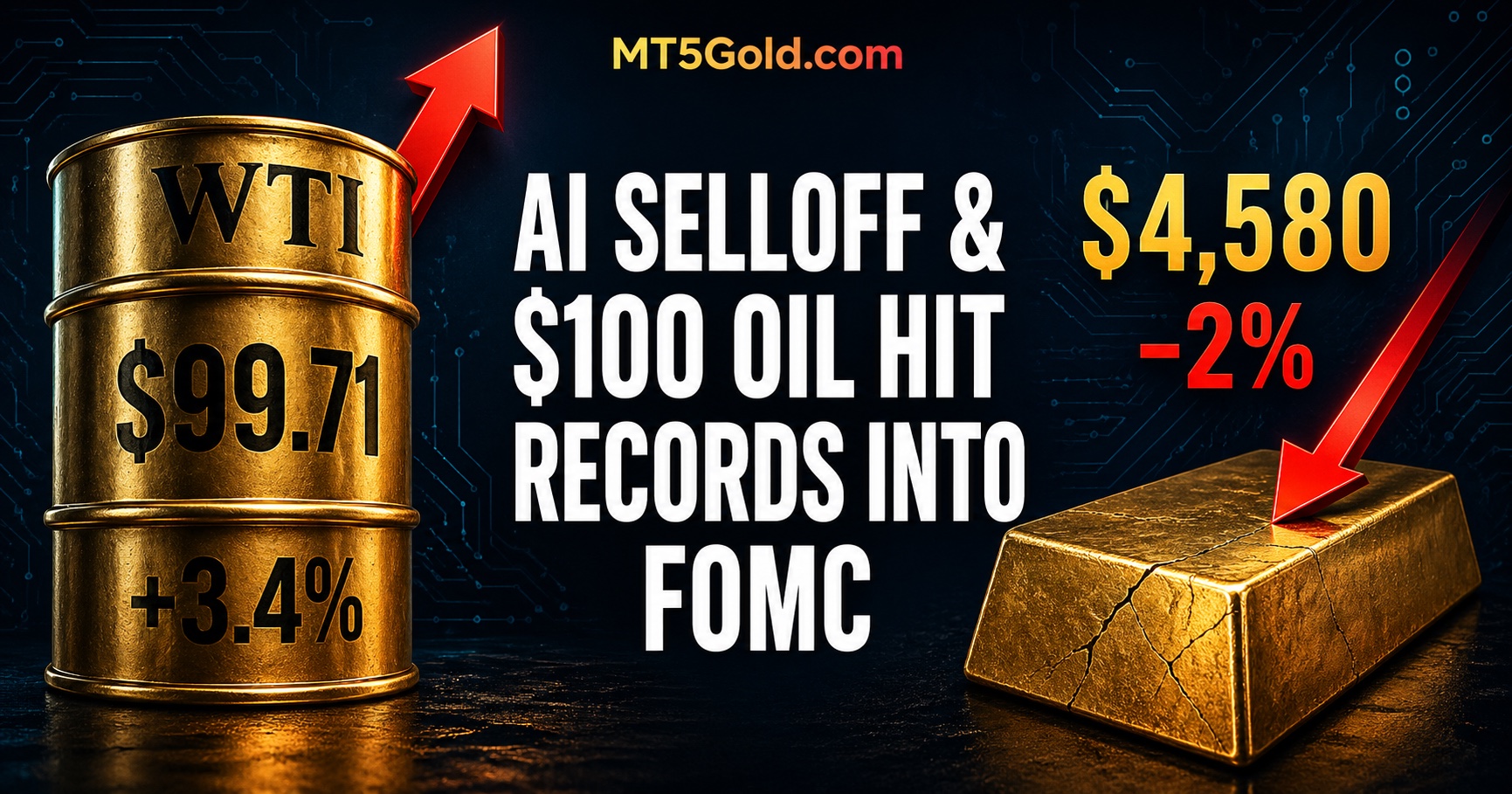
2. WTI $94.10 and fourth straight session higher: war premium is back in the strip
WTI crude traded $94.10 overnight, a fourth consecutive session of gains and the highest print of the month. Brent is near $96. The move is a direct function of the tanker interception tape layered on the existing Hormuz disruption: if three Iranian tankers bound for Asia were turned away in a single 24-hour window, the replacement barrels have to come from Saudi spare capacity or the US SPR release, and neither source flows instantly. The 12% oil plunge that printed on April 17 when the Strait of Hormuz first reopened has now been fully erased.
The reference levels for structure are clean. Bullish continuation trigger above $96 opens the psychological $100 handle where the inverted head-and-shoulders measured move points. Bearish invalidation runs through $88 first (prior shelf) then $85 (the level the Energy Department modelling assumes for normalized tanker flow). The key point: sub-$85 WTI still requires a material de-escalation in either the blockade operation or the ship-seizure cycle, neither of which is visible on the wire this morning. Equity sectors to watch are energy (XLE sitting at year-highs), airlines (fuel-cost headwind), and consumer discretionary (gasoline pass-through at the retail pump over the next two weeks).
- WTI $94.10 (+1.1%) -- fourth straight session of gains; Brent near $96; April low of $79 now a distant memory
- Bullish continuation above $96 opens the $100 psychological; measured move from the inverted H&S pattern points there
- Bearish invalidation through $88 then $85 -- requires the Hormuz transit and blockade tape to ease meaningfully
- Sector rotation: XLE leadership, airline/discretionary pressure, gasoline retail pass-through next 2 weeks
3. Tesla $373.60 (-3.59%): the $25B capex line broke the after-hours rally
Tesla cash-market closed Thursday at $373.60, down 3.59%, for a year-to-date decline of 17%. The setup was simple. Wednesday's post-close Q1 print delivered an EPS beat ($0.41 vs $0.38 consensus) that initially pushed the stock up roughly 4% in extended trade. Then the 2026 capex guide landed: over $25 billion, up $5 billion from the $20 billion call the prior quarter. CFO commentary on the call locked in expected negative free cash flow for the rest of 2026 to fund AI compute and Optimus/Robotaxi capacity, with the quarterly cadence roughly $7.5 billion per quarter for Q2, Q3, and Q4.
The Fortune accounting breakdown is the cleanest way to read the quarter: of the $491 million in GAAP profit, only $21 million came from core vehicle and battery operations. $297 million was carbon credits, $173 million was Bitcoin gains. Over the last two trailing quarters, core operations actually lost roughly $70 million. That recasts the P/E math: Tesla's adjusted trailing P/E, stripping credits and BTC, is near 657 against a $1.4 trillion market cap. The market is being asked to underwrite the AI/Robotaxi pivot on faith while core auto margins stay thin and capex steps 25% higher. Key reference zones for the stock: $360 is the prior shelf, $380-$390 is the prior consolidation lid, and the 200-day sits near $340.

- TSLA $373.60 (-3.59%) -- year-to-date -17%; post-earnings gap closed then broke lower
- 2026 capex lifted to $25B+ from $20B -- negative FCF for the rest of the year baked into guidance
- $21M core auto profit out of $491M GAAP -- the rest was credits ($297M) and Bitcoin ($173M)
- Reference zones: $360 prior shelf, $380-390 former consolidation lid, 200-day near $340
4. SPX 7,108.40 (-0.41%): Wednesday's record gave back, overnight futures flat
Thursday's cash close on the S&P 500 was 7,108.40, down 0.41%, giving back roughly half of Wednesday's +1.05% record-day move. The pullback catalyst was the tanker interception headline hitting the wire around the US open and the software-sector bid unwinding alongside the broad tape. Nasdaq Composite closed lower too, led by Tesla's drop and by software names retracing Wednesday's AI bounce. Dow finished roughly flat as energy leadership offset the industrial drag. Overnight, ES futures trade near 7,133.75 (-0.06%), Nasdaq futures are mixed, Dow futures slightly lower.
The structure read: 7,126 (Friday April 18 ATH) flipped to resistance as cash closed beneath it, and the reference floor moves down to 7,060 (Tuesday's shelf) and 7,000 (the round number that held on April 14 and 17). The tape is still in an uptrend but the record-day acceleration from Wednesday is not following through. For the April 14 ATH break setup that kicked off this leg, see the Monday of that week. The FOMC on April 28-29 is now the dominant event within four trading days, and Powell's last presser as chair carries outsized tone risk for rate-sensitive multiples.
- SPX 7,108.40 (-0.41%) -- Thursday gave back half of Wednesday's record move on the Iran tanker tape
- 7,126 flipped to resistance; new reference floors at 7,060 (Tuesday shelf) and 7,000 (round number support)
- ES overnight 7,133.75 (-0.06%) -- futures stable but not following through higher
- FOMC April 28-29 in four trading days -- Powell's final presser dominates from here
5. Warsh still blocked 12-12: Powell chairs the April 29 FOMC either way
Kevin Warsh's Fed Chair nomination is still stuck at the Senate Banking Committee. Composition is 13 Republicans, 11 Democrats. Democrats are uniformly opposed, Senator Thom Tillis is the sole Republican refusing to advance the vote, and his condition remains explicit: the DOJ investigation into Jerome Powell tied to the Fed headquarters renovations must be dropped first. With Tillis holding, the panel ties 12-12 and under Senate rules a tie-vote nomination does not advance to the floor. There is no procedural workaround that does not run through resolving Tillis directly. Powell's current term as Chair ends May 15, which means he chairs the April 28-29 FOMC as scheduled, and plausibly stays on as Chair-pro-tem beyond May 15 until Warsh or an alternate nominee is confirmed.
The rate-market setup into next Wednesday: the current range is 3.50% to 3.75%, and CME FedWatch has April priced at roughly an 85% hold probability with the first cut pushed to the June 17 meeting (where dot updates land). The dovish scenario is a hold paired with language that explicitly keeps multiple 2026 cuts alive, which would open $5,000 gold and drive BTC toward $80K. The hawkish scenario is a hold that leans harder into inflation persistence language, which retests $4,650 gold and puts BTC back at $75K. April is not a SEP meeting so there are no new dots, making wording the entire trade.
- Committee math 12-12 -- Tillis blocks, DOJ probe on Powell must be dropped first; no rule workaround
- Powell chairs April 28-29 FOMC and plausibly stays Chair-pro-tem beyond May 15 until a successor clears
- Rate strip: 85% April hold, first cut priced at June 17 (the SEP meeting with new dots)
- Dovish tone = $5K gold / $80K BTC test; hawkish tone = $4,650 gold / $75K BTC revisit
6. Crypto range-bound: BTC $77.7K and ETH $2,305 digest the Iran tape
Bitcoin prints $77,755 per TradingView BTC/USD overnight with a 24-hour change of -0.66%. CoinMarketCap puts the same spot at roughly $77,686 inside normal exchange dispersion. ETH trades $2,305.80 (-0.07%), sitting just above the $2,300 shelf that has been defended every test this month. The pullback is measured and mechanical rather than structural: no ETF outflow signal, no material funding-rate stretch, and no visible liquidation wick.
The April pattern has held: spot BTC ETF flows have absorbed every dip at progressively shallower discounts, and there has been no daily close below $75,000 all month. The functional range into the April 29 FOMC is $76K to $80K, with a dovish Powell tone opening $82K and a hawkish surprise retesting $75K. ETH lags BTC on softer spot ETH ETF inflows versus March, but the $2,300 floor has held and BTC dominance continues climbing. For the weekly structure and flow read heading into this FOMC week, see the April 19 weekend recap.
- BTC $77,755 (-0.66%) -- $2,300 ETH shelf and $76K BTC floor both holding; no stress in funding or ETF flows
- ETH $2,305.80 (-0.07%) -- lags BTC but the floor is still structurally defended
- No April BTC daily close below $75K -- spot ETF bid has absorbed every dip this month
- FOMC range: $75K-$82K -- tone and wording set the path, not the rate decision itself
7. What to watch today and into next week
- Intraday Friday -- Iran tanker / blockade tape: every additional CENTCOM interception headline moves WTI $1-$2 and S&P 20-40 bp on the day. This is the primary macro driver. IMPACT: HIGH.
- Pre-market and open -- TSLA follow-through: the $360 shelf and $380-$390 former lid are the reference band after Thursday's -3.59% flush. Tape reaction here feeds Nasdaq breadth. IMPACT: HIGH for TSLA, MEDIUM for QQQ.
- US session -- S&P Global flash PMIs (April): manufacturing and services flash releases feed into FOMC language by signalling activity momentum. IMPACT: MEDIUM.
- US session -- UoM consumer sentiment (final April): inflation-expectations subcomponent is the print the Fed watches most closely at a household level. IMPACT: MEDIUM.
- Tuesday April 28 through Wednesday April 29 -- FOMC decision and Powell presser: 85% hold priced, no new dots, wording is the entire trade. Dovish lean opens $5,000 gold and $82K BTC; hawkish lean retests $4,650 gold and $75K BTC. IMPACT: EXTREME.
- Following week -- April nonfarm payrolls: first post-FOMC data point; currently tracking a cooling labor market which keeps the rate-cut path alive.
- Iran tanker tape stays the lead macro driver until blockade interceptions slow or Hormuz transit normalizes
- TSLA cash follow-through sets Nasdaq breadth for the day; $360 reference floor is the key level
- FOMC next Wednesday is the wording trade -- no new dots, Powell's final presser, outsized tone risk
- Payrolls in 2 weeks re-engages the rate-cut path debate once the FOMC language is digested