1. WTI Tops $100 as Trump Rejects Iran's Hormuz Proposal
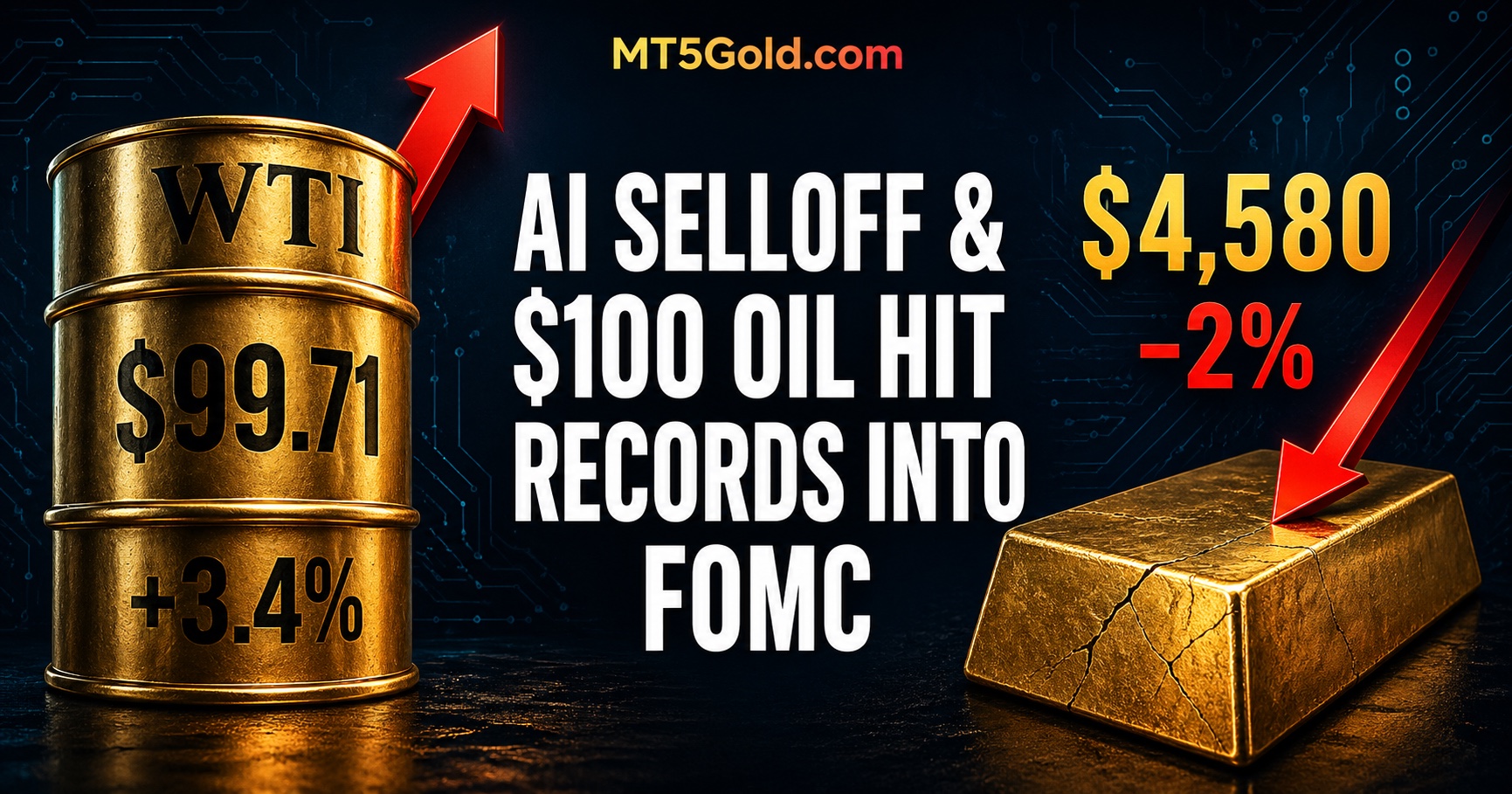
Oil is the dominant tape this morning. West Texas Intermediate futures jumped roughly 3.4% to $99.71 per barrel intraday, with prints above $100 on the upper extension after a New York Times report said President Trump is dissatisfied with Iran's weekend proposal to reopen the Strait of Hormuz. The objection is structural, not tactical: the Iranian text bundles the strait reopening and a war ceasefire while postponing nuclear talks to a later phase. The White House precondition has been the opposite, a single integrated deal with the atomic file front and center. Brent printed near $111, Brent up about 3% on the session and gasoline futures extending the inflation impulse into the AAA national average, which now sits at $4.176 per gallon, the highest reading since August 2022.
The structural read is that the standoff itself has not changed. Mutual restrictions between Iran and the US continue to choke traffic through the strait to near zero, the route still carries roughly 20% of global energy flow, and Tehran's nuclear program remains the unresolved variable. What changed today is the curve's read of the diplomatic timeline: the market had partially priced a near-term thaw on the back of yesterday's reporting, and that pricing is now unwinding. For the structural Hormuz framework that landed Monday, see Monday's morning analysis.
- WTI $99.71 (+3.4%), Brent ~$111, with prints above $100 intraday on the seventh consecutive day of gains
- Trump rejected Iran's proposal because it postpones nuclear talks; the strait remains effectively closed
- Inflation impulse is back: AAA national gas at $4.176, highest since August 2022, complicating the FOMC tone calculus
2. OpenAI Revenue Miss Triggers AI Infrastructure Selloff
The second tape-mover is internal to the AI complex. A Wall Street Journal report this morning detailed that OpenAI has fallen short of internal revenue and user-growth benchmarks, with CFO Sarah Friar reportedly telling leadership she is concerned the firm may not be able to service its compute contracts if top-line growth does not accelerate. ChatGPT's share of generative AI web traffic has slipped from 86.7% a year ago to 64.5% in January 2026, with Google's Gemini climbing from 5.7% to 21.5% over the same window. The financing chain that supports OpenAI's compute build is the question the equity tape is asking: if the customer can't pay, the suppliers carry the working-capital risk.
The selling is concentrated in the firms most exposed to that financing chain. Oracle (ORCL) -5.2% was the focal point given its reported $300 billion, five-year cloud-compute deal with OpenAI. CoreWeave (CRWV) tumbled on similar exposure. AMD and Intel both -4%, Nvidia (NVDA) and Broadcom (AVGO) -3% to -5%, all of which have taken the OpenAI partnership flow as a meaningful revenue line. SoftBank dropped roughly 10% in Tokyo overnight. The S&P 500 trades 7,126.42 (-0.66%) off Monday's record close of 7,173.93; the Nasdaq Composite 24,592.37 (-1.18%). The Dow is the outlier, holding green on rotation into energy and defensives.
- OpenAI funding risk is now a tape variable: WSJ report that CFO flagged compute-contract solvency to leadership
- Concentrated AI infra selloff: Oracle -5.2%, AMD -4%, Intel -4%, NVDA -3% to -5%, AVGO down, SoftBank -10% in Tokyo
- Index-level damage limited so far: S&P -0.66%, Nasdaq -1.18%, Dow flat-to-green on energy rotation
3. FOMC Two-Day Meeting Begins; Powell Tone Is the Trade
The April 28-29 FOMC opens today. The CME FedWatch tool prices a hold at roughly 99% probability, and this is a non-SEP cycle, meaning no fresh dot plot, no updated economic projections, and no new staff forecasts. The single variable on the tape Wednesday is Powell's tone in the press conference at 18:30 UTC. The two-shock cross-current opens this morning materially complicates that calculus: the oil-driven inflation impulse pushes hawkish, the AI-driven equity wobble pushes dovish. Markets coming into the meeting were leaning toward a dovish-leaning hold consistent with PCE softness; today's oil move is a fresh hawkish lean.
The dovish path Wednesday is a hold paired with statement language explicitly keeping multiple 2026 cuts alive (June 17 SEP meeting is the live cut window in the strip). The hawkish path is sticky-inflation language acknowledging the oil pass-through. This is also Powell's likely final FOMC presser as chair: his term ends May 15, and the Warsh confirmation remains stuck 12-12 in committee, so tone risk is structurally elevated. For the operational framework into Wednesday, see our FOMC bracket playbook.
- Non-SEP cycle: no dot plot, no projections; Powell's tone is the entire variable
- Cross-current calculus: oil shock pushes hawkish, AI wobble pushes dovish, complicating the lean
- Likely final Powell presser as chair: term ends May 15, Warsh confirmation stuck, tone risk elevated
4. Gold Plunges 2% as Real Yields Climb
Gold is the cleanest casualty of the rotation. XAU/USD trades $4,585.95 (-2.08%), the lowest print since late March and a $125 leg lower from yesterday's same-hour reading. The driver is mechanical: WTI above $100 lifts breakeven inflation expectations, the dollar bids on the safe-haven flow alternative, and the 10-year nominal yield grinds higher on the renewed inflation pulse, all of which compresses real yields against the metal. April's high of $5,000 printed earlier in March and the consolidation since has been a slow drip lower; today's break is the first decisive move below the $4,650 reference zone we flagged Monday.
Structurally, the next reference floor is $4,500, a confluence of the March 12 swing low and the prior cycle breakout pivot. A dovish Powell tone Wednesday would re-engage the bid into $4,700-$4,780; a hawkish tone keeps gold pinned and opens a test of $4,500. The structural buyer thesis has not changed (central bank reserve diversification, BRICS ex-dollar settlement, sovereign demand into the H2 cycle), but the tactical positioning is unwinding hard into the binary.
- XAU $4,585.95 (-2.08%), lowest since late March, $125 down from yesterday's hour-on-hour
- Real yields are the lever: oil-driven breakeven lift plus nominal yield grind compresses real yields against metal
- Reference zones into FOMC: bullish trigger $4,700-$4,780 on dovish tone, bearish extension to $4,500 on hawkish tone
5. Bitcoin Tests $75K Floor; ETH Quiet at $2,281
Crypto is leaking with risk. Bitcoin trades $76,400 (-1.96% 24h), with intraday prints as low as $76,187 on Coinbase and TradingView showing $75,897 at one point. The functional April range has been $75K-$80K, and BTC has not had a daily close below $75,000 all month; today is the third test of the floor in seven sessions. The mechanism of support remains the same one that has held since early March: spot BTC ETF flows continue absorbing dips at progressively shallower discounts, with last week's $824 million inflow the fourth straight week of net positive flow. A daily close below $75,000 would be the first technical break of the April structure and a meaningful change of character.
Ethereum prints $2,280.60 (-0.23%), holding the $2,300 area that has acted as the structural pivot since March. ETH continues to underperform BTC in relative terms because spot ETH ETF inflows have decelerated since March, but the floor has held every test. The structural reads into Powell are simple: a dovish tone re-engages BTC at $78K-$80K and lifts ETH back through $2,400; a hawkish tone tests $74K BTC and $2,200 ETH.
- BTC $76,400 (-2.0%), third test of $75K floor in seven sessions; daily close below would be a structural break
- Spot BTC ETF flows still absorbing dips: fourth straight week of net inflows, $824M last week
- ETH $2,280.60 (-0.23%), $2,300 pivot holding; underperforms BTC on slowing spot ETH ETF flow
6. What to Watch: Mag 7 Earnings, Powell, PCE
The week's binary stack is dense and front-loaded. Today (Tuesday April 28) is FOMC Day 1, plus a CB Consumer Confidence print and JOLTS Job Openings; the AI-infrastructure bid is on watch into close. Wednesday April 29 is the macro day of the year so far: FOMC decision at 18:00 UTC, Powell press conference at 18:30 UTC, plus Durable Goods, Building Permits, EIA Crude Inventories, and Housing Starts. After the close on the same Wednesday, Microsoft (MSFT), Meta (META), Alphabet (GOOGL), and Amazon (AMZN) all print Q1 earnings on the same evening. The narrative thread connecting all four is AI capital expenditure versus revenue conversion, which is exactly the question the OpenAI report is forcing the market to ask today.
Thursday April 30 delivers Q1 Advance GDP and the PCE Prices report (the Fed's preferred inflation gauge, first read post-FOMC), with Apple (AAPL) printing after the close. Friday May 1 closes the week with ISM Manufacturing as the first post-FOMC sentiment read. For positioning across crypto, oil, equities and gold into this stacked calendar, Bybit's TradFi platform offers tight spreads on BTC, ETH, SPY and WTI futures with defined-risk tooling. See Monday's morning analysis for the FOMC-week structural setup and the full economic calendar for the Tuesday-Friday catalyst stack.
- S&P 500: 7,165 record reference; bullish continuation above 7,200, bearish trigger on close below 7,100
- WTI: $100 round number, then $103-$105 if the strait stays effectively closed; bullish through $107 Brent
- Gold: $4,500 structural floor, $4,700-$4,780 dovish-tone re-engagement zone
- BTC: $75,000 structural floor (April month not yet closed below), $80,000 cycle resistance
Nothing in this analysis is investment advice or a personal recommendation. These are structural reference points and macro context for traders who already understand position sizing and risk management. The framework is the framework: levels for risk, scenario reads for direction, discipline to wait for both before acting. For the daily structural reads on individual assets, see our market insights feed.