1. Peace talks collapse in Islamabad -- Trump orders Strait of Hormuz blockade
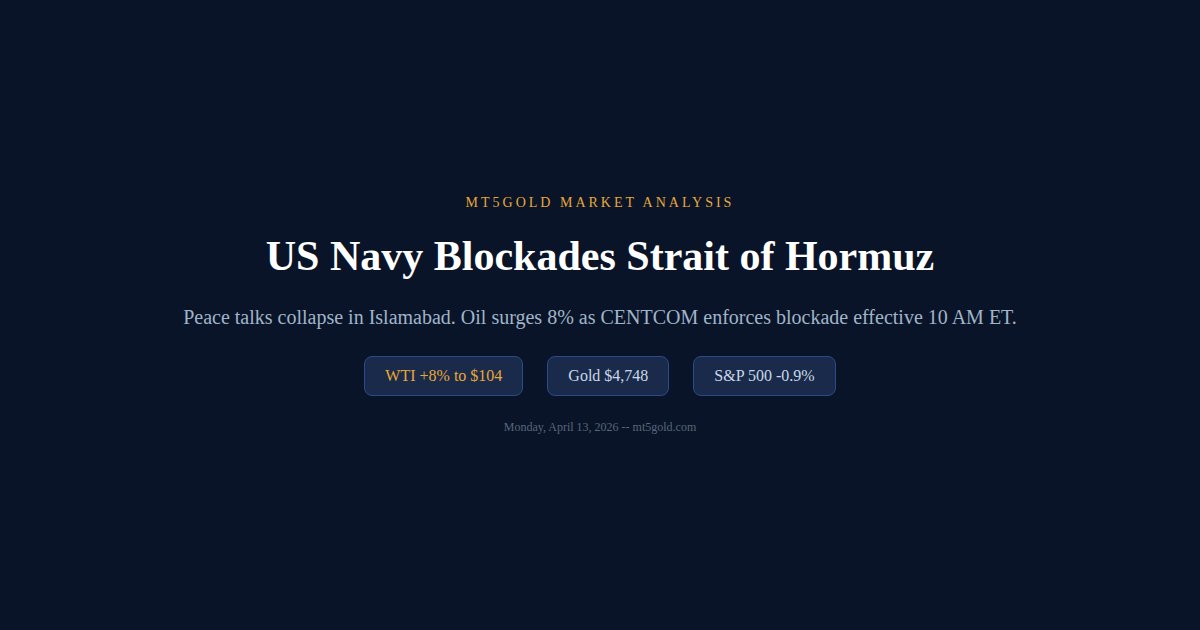
The week's defining story began in Islamabad on Sunday. VP JD Vance led a US delegation into last-ditch talks with Iranian negotiators, but the two sides could not bridge the gap on nuclear enrichment rights. By Sunday afternoon, Vance departed Pakistan without an agreement, citing Iran's "unwillingness to give up its efforts to obtain a nuclear weapon." President Trump responded within hours, announcing on Truth Social that the US Navy would impose a maritime blockade on Iranian ports starting at 10 AM Eastern Time on Monday.
US Central Command clarified the scope: the blockade does not apply to vessels transiting the Strait of Hormuz to or from non-Iranian ports. But the Navy is tasked with intercepting every vessel that paid a transit toll to Iran -- a direct challenge to the IRGC's crypto-denominated toll system that has been extracting fees from global shipping since the conflict escalated. Iran called the blockade "illegal" and "an act of piracy," warning of consequences that go beyond economics.
Why the talks failed:
- Iran refused to acknowledge any restrictions on its nuclear enrichment program
- The US demanded written verification of enrichment caps -- Iran rejected this as a sovereignty violation
- VP Vance had a fixed departure window; the talks collapsed within the final hour of negotiations
- Trump's blockade order came via Truth Social within 90 minutes of Vance's departure from Islamabad
- Ceasefire to blockade in under 5 days -- the most dramatic geopolitical reversal since the conflict began
- Blockade scope: Iranian ports only -- Hormuz transit for non-Iranian vessels still permitted under CENTCOM rules
- Iran's crypto toll system now targeted -- direct US interdiction of IRGC-linked vessels escalates enforcement
- Nuclear rights remain the dealbreaker -- no diplomatic path visible until this core issue is resolved
2. Oil back above $104 -- last week's ceasefire crash is fully reversed
WTI crude surged 8.0% to $104.32 this morning, reversing more than half of last week's 14% ceasefire-driven collapse in a single session. Brent crude gained 7.3% to $102.51. The move happened almost entirely in overnight futures trading on Sunday after Trump's announcement, meaning US equity markets are absorbing the full shock at Monday's open. The 800-vessel backlog in Hormuz that formed during the initial closure has not cleared, and a US naval blockade of Iranian ports extends the supply normalization timeline by weeks.
Energy stocks that gave back 5-7% on last week's ceasefire announcement will open sharply higher. Airlines and cruise operators that popped on cheaper-fuel hopes will give those gains back. The $90-105 range that formed during the ceasefire period is now being re-tested from the upside -- a break above $105-106 would target the pre-ceasefire highs near $112. For detailed oil price context from last week, see our April 12 weekly recap.
- WTI at $104.32, +8.0% -- the full ceasefire relief rally in oil is erased in one session
- Brent at $102.51, +7.3% -- global benchmark confirms the move; both back above $100
- 800+ vessel backlog persists -- supply normalization pushed out further; no near-term relief
- $105-106 is next resistance -- a break would signal markets repricing toward pre-ceasefire highs near $112
3. S&P 500 set to open down 0.9% -- blockade re-prices last week's relief rally
S&P 500 futures lost 1.1% in overnight trading. The index is set to open near 6,756, down 0.9% from Friday's close of 6,817 -- which was the best weekly close since November 2025. The Dow dropped more than 500 points in overnight trading before paring some losses. Nasdaq futures fell harder than the broader index, hit by the combination of rising oil-inflation expectations and rising Treasury yields that pressure high-multiple tech names.
The Fed timing question is back on the table. Last week's core CPI at 2.6% gave the Fed room to stay patient. Oil back above $100 means the April CPI reading -- releasing in mid-May -- will reflect elevated energy prices rather than the brief ceasefire-week relief window. Rate-cut odds ticked lower overnight, and 10-year Treasury yields are rising again, adding a second headwind for growth stocks alongside the inflation re-acceleration signal.
- S&P 500 at 6,756, -0.9% -- last week's best-week-since-November partially reversed in one overnight session
- Nasdaq hardest hit -- rising oil plus rising yields is a double headwind for growth stocks
- Rate-cut odds falling again -- April CPI will reflect elevated oil, not ceasefire-week relief
- S&P 6,700 is the critical support -- a close below erases the ceasefire recovery thesis entirely
4. Bitcoin falls to $71,012; gold holds near $4,748 -- the safe-haven divergence continues
Bitcoin pulled back to $71,012 (-2.7%) as risk-off sentiment hit crypto alongside equities. The move is measured rather than a capitulation -- BTC is still well above the $67,000-68,500 structural support zone and holding above the $70,000 psychological floor. Ethereum fell more sharply to $2,185 (-3.3%), giving back part of last week's 7% recovery. The Fear & Greed Index, which was already stuck at extreme fear levels despite last week's price recovery, likely ticked even lower overnight.
Gold's behavior is the more instructive signal. At $4,748, XAU is down only 0.4% from Friday's close -- absorbing flight-to-safety flows even as risk assets sell off broadly. The gold vs. bitcoin divergence that has defined the entire conflict period continues: safe-haven capital is flowing to XAU while BTC trades like a risk asset rather than a store of value. The $4,704-4,731 range is the near-term support floor; $4,800 remains the level to break for any upside continuation.
- BTC at $71,012, -2.7% -- $70,000 psychological support holding; $68,500 is the real structural floor
- ETH at $2,185, -3.3% -- more volatile than BTC but still holding above $2,000 key support
- Gold at $4,748, -0.4% -- significantly more resilient; safe-haven flows favoring XAU over crypto
- Gold range today: $4,731-4,795 -- holding above $4,731 keeps the bull structure intact heading into JPMorgan earnings
5. JPMorgan earnings Tuesday -- earnings season opens under blockade conditions
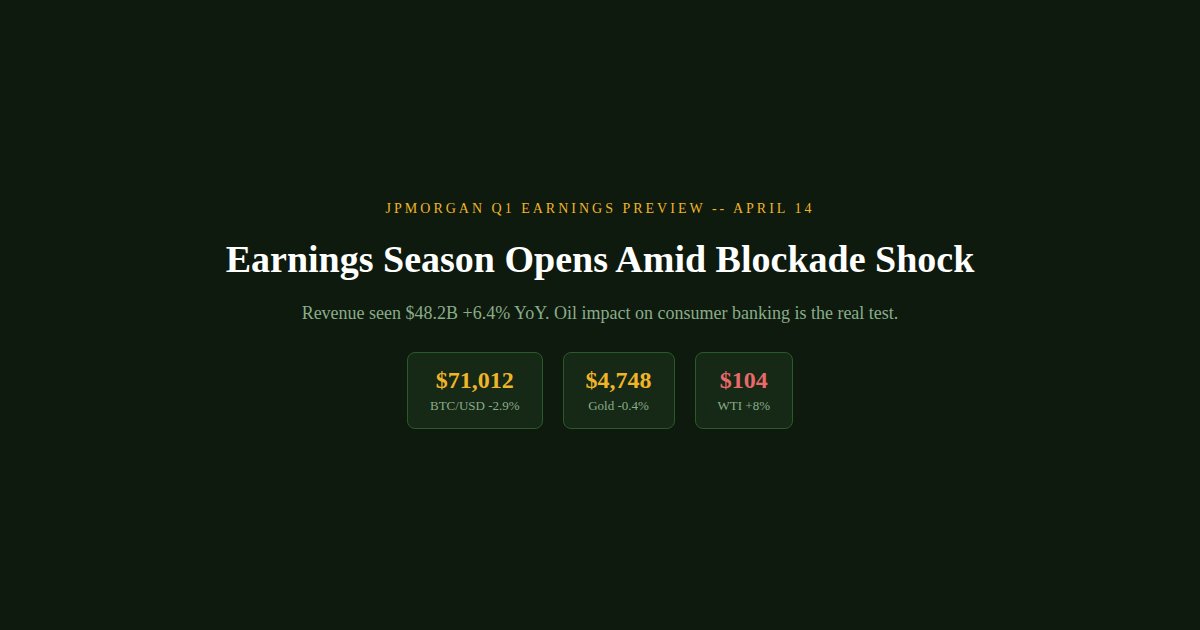
JPMorgan reports Q1 2026 results at 7 AM ET Tuesday -- the first major bank earnings of a quarter dominated by the Hormuz conflict and energy volatility.
JPMorgan Chase reports Q1 2026 earnings before the opening bell on Tuesday at 7 AM ET. Consensus expects revenues of $48.2B (+6.4% YoY) and net interest income of $25.6B (+10.1%). Q1 2026 was an exceptional quarter for bank trading desks -- the Hormuz closure in late February sent oil above $110, generating outsized volatility revenue across fixed income, equities, and commodities. The retail banking side faced the other side of that trade: a gasoline shock that acted as a regressive tax on millions of customers and likely elevated early delinquency signals.
Management commentary will move markets more than the headline EPS number. Watch for language on loan loss provisions, the investment banking pipeline, and -- most critically -- CEO Jamie Dimon's read on the Q2 outlook now that a blockade has replaced the ceasefire. Bank of America follows the same morning alongside March Retail Sales (consensus +0.3% MoM), creating a double-catalyst session for consumer spending and credit trends.
- JPMorgan Q1 at 7 AM ET Tuesday -- revenues seen $48.2B, NII $25.6B; EPS is the headline, commentary is the signal
- Trading desks had a banner Q1 -- watch whether this offsets retail banking consumer stress and delinquency trends
- Q2 outlook under blockade conditions -- Dimon's geopolitical risk language will be parsed closely by every desk
- March Retail Sales same morning, +0.3% MoM expected -- a miss would amplify the risk-off session significantly