1. JPMorgan Q1 2026 -- EPS $5.94 Smashes Estimates, But NII Guidance Cut Sends Stock Down 3%
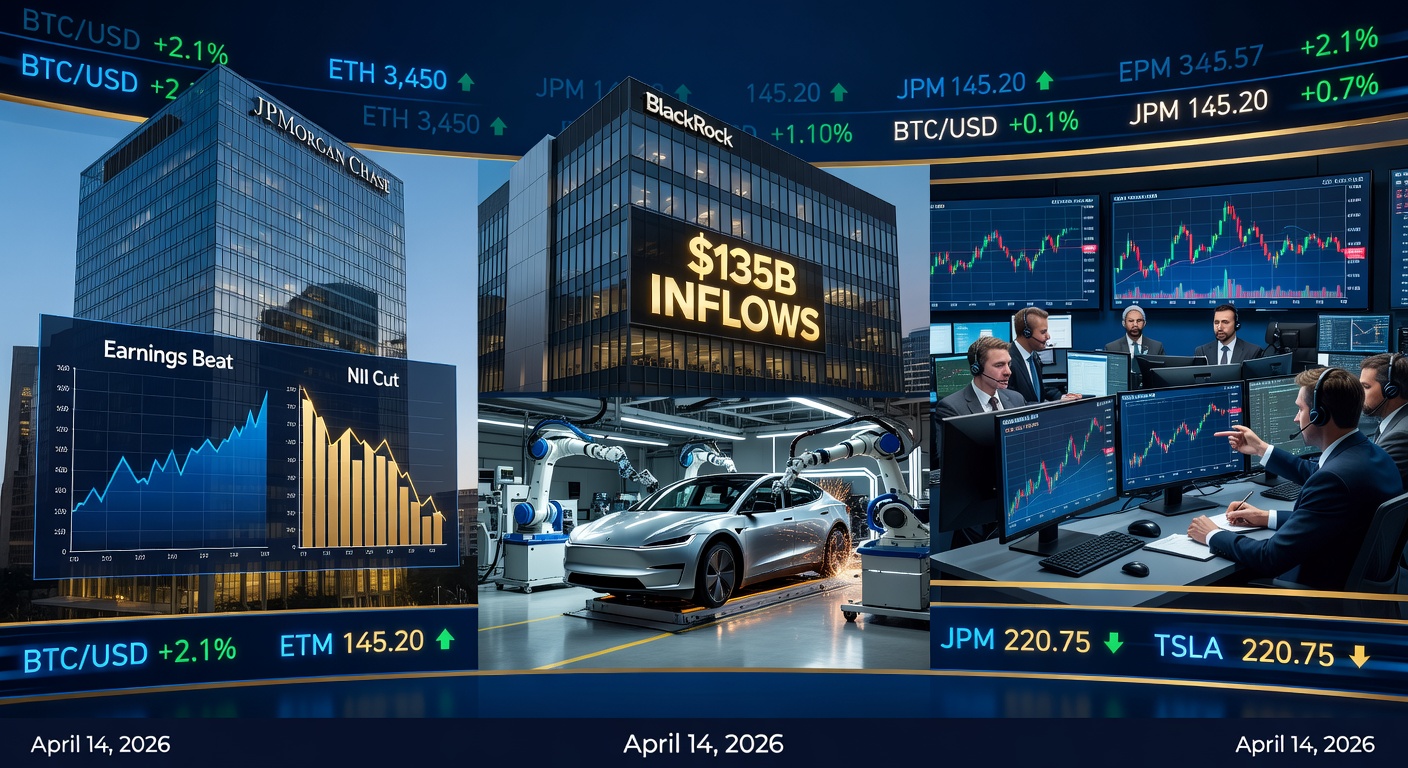
JPMorgan Chase opened Q1 earnings season with its fifth consecutive beat, reporting adjusted EPS of $5.94 against the $5.46 consensus and revenue of $49.8 billion versus the $49.17 billion estimate. Investment banking fees surged 28% year-over-year to $2.9 billion. Fixed-income markets revenue rose 21% to $7.1 billion, with Hormuz-driven volatility in oil, FX, and rates creating a record trading environment across the quarter.
Shares fell roughly 3% in early trading. The market's initial reaction turned negative as management trimmed its full-year net interest income guidance to $103 billion, down from the prior $104.5 billion forecast. CEO Jamie Dimon flagged an "increasingly complex" global risk environment -- a phrase that historically precedes further revision. The spread between the earnings beat and the NII cut tells the real Q1 story: the bank made more than expected on trading but borrowed less cheaply than it had planned for the year ahead.
- JPM EPS $5.94 vs $5.46 est -- fifth straight beat; investment banking fees up 28% and fixed-income markets up 21% drove the outperformance
- NII guidance cut to $103B from $104.5B -- this one line moved the stock more than the earnings beat lifted it; watch July earnings for another revision
- Dimon flags "increasingly complex" risks -- historically precedes further guidance cuts; Q2 guidance credibility is now in question
- Bank of America reports tomorrow -- $0.99 EPS and $29.6B revenue expected; JPM's NII cut sets a cautious tone for the sector
2. BlackRock Q1 2026 -- $130B in Inflows, EPS Surges 46%, AUM Reaches $13.9T
BlackRock reported first-quarter results today showing $135.9 billion in long-term net inflows, the strongest single-quarter intake the firm has recorded. Total inflows over the trailing 12 months hit $620 billion. AUM reached $13.9 trillion, up sharply from $11.58 trillion a year ago, though slightly below the $14.04 trillion record set in Q4 2025 as market-value headwinds partially offset strong flows.
Adjusted EPS of $14.06 crushed the $11.09 consensus by 27%. Revenue rose 27% to $6.7 billion against the $6.46 billion estimate. The long-term organic asset growth rate hit 13% on a trailing 12-month basis, a dramatic acceleration from just 3% in Q1 2024. Bitcoin ETF inflows via iShares contributed to the strong institutional demand picture across alternative asset classes.
- EPS $14.06 vs $11.09 est -- 27% beat; revenue $6.7B vs $6.46B est; the widest earnings margin vs. consensus in recent history
- $135.9B Q1 long-term inflows -- best quarter on record; $620B over 12 months signals sustained institutional allocation to risk assets
- AUM $13.9T, up from $11.58T a year ago -- near-record but slightly below Q4 2025 peak; flows strong but markets headwind trimmed the top
- 13% organic growth vs 3% in Q1 2024 -- the 10-point acceleration reflects ETF and alternatives demand that is structural, not cyclical
BlackRock's record $135.9B in Q1 inflows underscore sustained institutional appetite for risk assets and alternatives amid market volatility.
3. Deutsche Borse Takes $200M Stake in Kraken Ahead of IPO
Germany's Deutsche Borse AG invested $200 million in Payward Inc., the parent company of crypto exchange Kraken, taking a 1.5% stake in a deal that values the platform at approximately $13.3 billion. The transaction is expected to close in Q2 2026 subject to regulatory approval. It extends a partnership first announced in December 2025 focused on bridging traditional financial infrastructure with digital asset settlement rails.
The timing is explicitly linked to Kraken's anticipated IPO, per reporting from invezz and CoinDesk. For Deutsche Borse -- Europe's second-largest stock exchange operator -- this is a strategic bet that regulated crypto trading infrastructure will become a core financial utility. The $200 million secures a cap-table position before a listing that would crystallize the return and anchor Deutsche Borse as Kraken's longest-standing institutional partner.
- Deutsche Borse takes 1.5% for $200M -- values Kraken at $13.3B; a stock exchange buying a crypto exchange is infrastructure-level institutional adoption
- Deal close Q2 2026 -- pending regulatory approval; extends December 2025 partnership into equity ownership
- Pre-IPO positioning -- $13.3B is the reference valuation; Deutsche Borse locks in ahead of a public listing at a likely higher price
- TradFi-crypto rails convergence -- not a fund manager, a stock exchange; the signal is that digital asset settlement infrastructure is being absorbed into legacy market plumbing
4. Tesla Cybercab Production Starts in April, Robotaxi Fleet Spotted Testing in Phoenix
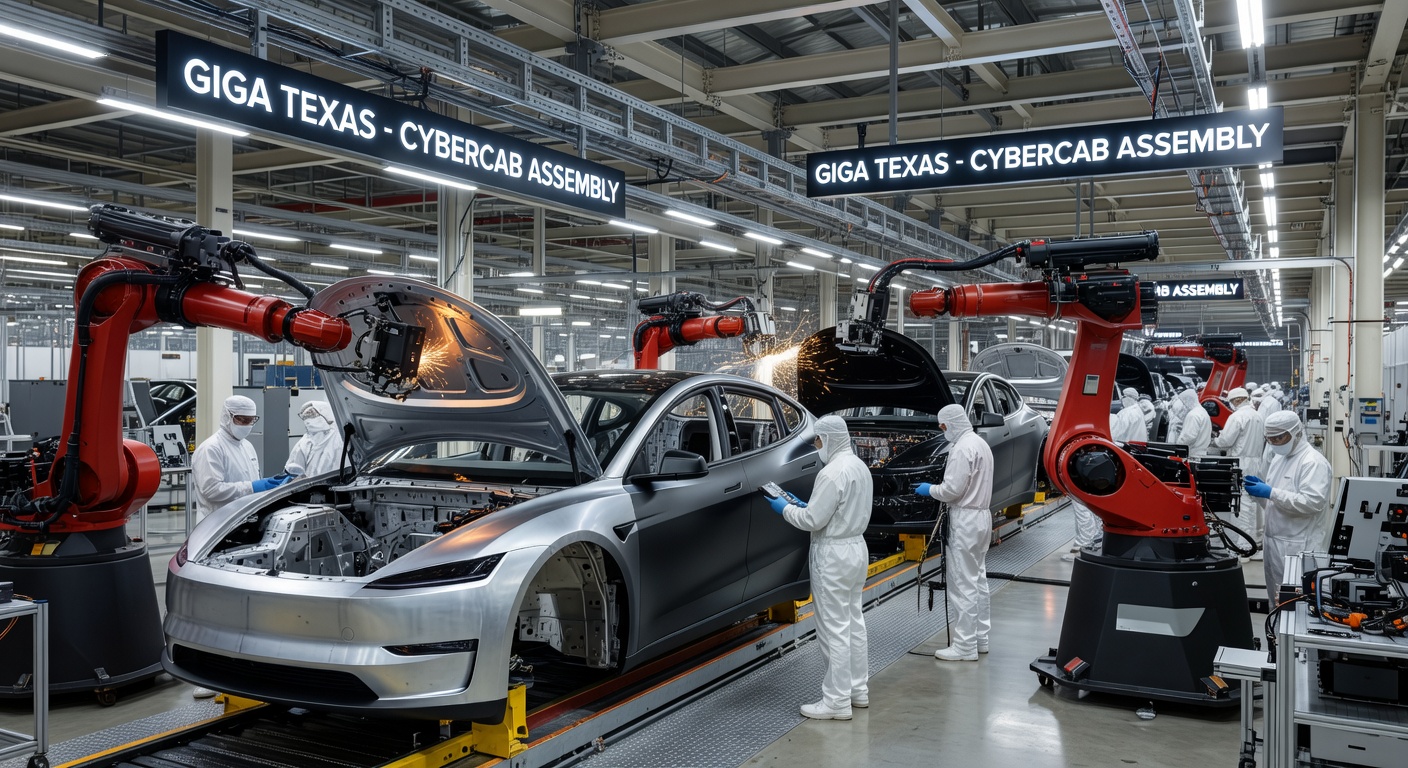
Tesla began production of its purpose-built Cybercab robotaxi this month, per reports from Benzinga and Electric Vehicles. A fleet of approximately 60 Model Y vehicles has been spotted conducting pre-launch testing in Phoenix with upgraded rear camera washers, indicating the city's robotaxi launch is imminent. The confirmed first-half 2026 expansion list covers seven cities: Dallas, Houston, Phoenix, Miami, Orlando, Tampa, and Las Vegas, each pending local regulatory sign-off.
Bank of America estimates Tesla's vision-only autonomous system puts Cybercab build costs at roughly $40,000 per unit versus $150,000 for Waymo's LiDAR-equipped vehicles -- a 3.75x structural cost advantage at scale. Elon Musk has outlined a long-term target of service coverage in dozens of US cities representing 25 to 50% of the country by end of 2026.
- Cybercab production started April 2026 -- purpose-built robotaxi enters manufacturing; execution risk shifts to city-by-city regulatory approvals
- 60 Model Ys testing in Phoenix -- fleet size signals imminent launch; 7 H1 cities confirmed with Phoenix likely first after Austin
- BoA cost edge: $40K vs Waymo's $150K -- if Tesla sustains this gap at scale, the unit economics of autonomous ridesharing change permanently
- Musk target: 25-50% US coverage by end of 2026 -- aggressive; the Phoenix fleet validates that execution is underway, not just planned

Tesla's Cybercab production ramp signals the robotaxi era is shifting from announcement to real-world deployment with 60 units testing in Phoenix and seven cities lined up for H1 launch.
5. CLARITY Act Countdown -- Senate Has Roughly 14 Working Days Before Recess Kills Momentum
A detailed analysis published today by CryptoTimes warns that the Senate Banking Committee has approximately 14 working days remaining in its viable markup window before August recess politics consume the legislative calendar. The Digital Asset Market CLARITY Act aims to assign CFTC jurisdiction over digital commodities -- including Bitcoin, Ethereum, Solana, and XRP, all four of which received a joint SEC/CFTC commodity classification in March -- and SEC authority over investment contracts.
The central negotiating impasse is stablecoin yield: whether holders of regulated stablecoins can earn interest. Banks argue that yield-bearing stablecoins would trigger deposit flight. Crypto firms argue that non-yield stablecoins are uncompetitive against bank deposits. The SEC separately issued a new interpretation today clarifying how federal securities laws apply to specific crypto assets -- a move designed to reduce enforcement uncertainty while Congress finalizes the broader legislation. An April 16 roundtable is expected to surface the competing positions publicly.
- 14 working days left in markup window -- miss this window and the bill likely waits until after midterms; July is the last realistic Senate deadline
- Stablecoin yield is the single blocker -- not blockchain policy or token classification; one clause on interest payments is holding up the entire framework
- SEC issued crypto interpretation today -- complements the legislative effort; reduces enforcement ambiguity in the interim while the bill remains in committee
- ETH, SOL, XRP already commodity-classified -- March SEC/CFTC joint action gives the bill a foundation; the remaining fight is over stablecoins and DeFi oversight
6. Nvidia's 8-Day Winning Streak at $188, AMD Holds $245 as Meta AI Deal Gains Traction
Nvidia posted eight consecutive days of gains through last Friday, trading near $188.53 and approaching its 52-week high of $211.19. The sustained rally reflects institutional demand for AI compute ahead of Nvidia's next earnings on May 20, where consensus expects EPS of $1.62. AMD holds around $245, up roughly 15% since the February 24 announcement of the Meta partnership, which has become the defining institutional validation for AMD's data center thesis.
AMD's $60 billion, 6-gigawatt deal with Meta is progressing toward first-gigawatt deployment in H2 2026, powered by custom Instinct MI450 GPUs and 6th-generation EPYC Venice CPUs built on the open Helios rack-scale architecture. Meta's decision to split AI compute procurement across two vendors signals the end of single-supplier Nvidia dependency among hyperscalers. AMD's data center revenue grew 172% year-over-year in FY2025, versus Nvidia's 68%, though Nvidia's gross margins remain 23 percentage points higher.
- NVDA 8-day winning streak at $188.53 -- approaching 52-week high of $211.19; May 20 earnings is the next binary catalyst; beat is statistical base case
- AMD at $245, up 15% since Meta deal -- data center revenue +172% YoY; Meta partnership provides a multi-year revenue floor independent of Nvidia's dominance
- Meta splits AI spend across two vendors -- hyperscaler diversification signals the end of single-supplier chip dependency; AMD's open Helios stack is the alternative infrastructure
- MI450 deployment starts H2 2026 -- first gigawatt of Meta AI infrastructure begins real-world validation of AMD's enterprise pitch at scale